What Changed and Why It Matters
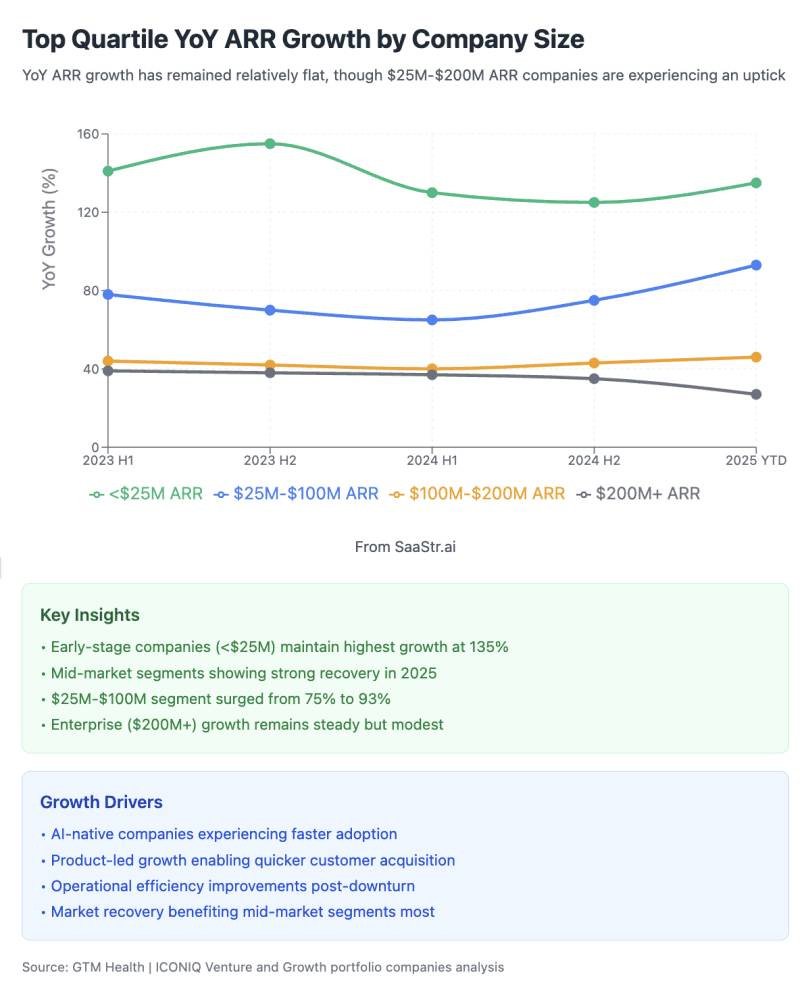
ICONIQ’s latest B2B SaaS readout puts a spotlight on where growth actually breaks loose. Mid-stage companies in the $25M–$100M ARR band are finally pushing past the “growth plateau,” and the common thread isn’t more leads — it’s better mid‑funnel execution.
“The Mid-Stage Breakout: Companies in the $25M-$100M ARR range are finally breaking free from what many call the ‘growth plateau.’” — SaaStr on ICONIQ’s 2025 findings
At the same time, operators are openly debating which AI levers move revenue fastest under $25M ARR — adoption nudges, usage-based pricing, or leaner sales motions. Case studies back it up: teams that fixed activation, qualification, and sales-assist saw step-change results without adding headcount.
Zoom out and the pattern becomes obvious: 2025 is the year GTM shifts from top-of-funnel obsession to mid‑funnel mastery — activation, expansion, and pricing — measured against efficiency metrics that boards understand.
The Actual Move
Across the ecosystem, the concrete moves are consistent:
- ICONIQ codifies a durability lens with the Enterprise Five — a framework of five core metrics representing long-term growth and efficiency. Teams are steering to these dials, not vanity leads.
- SaaStr’s coverage of ICONIQ’s 2025 GTM report highlights the breakout of $25M–$100M ARR companies, signaling process, pricing, and expansion are paying off.
- Operators are prioritizing AI in the mid‑funnel: onboarding nudges, product-qualified pipelines, usage-based pricing, and sales-assist — as surfaced in ICONIQ-linked operator discussions.
- A healthcare GTM transformation (GTM Partners) shows that fixing routing, qualification, and enablement can drive tens of millions in new revenue in months — without a new top-of-funnel engine.
- BlueJ’s decade-long journey from supervised ML to an LLM-powered tax research product correlates with ARR compounding from $2M to $25M — a product evolution that directly improves activation and time-to-value.
- Remofirst raises $25M after 10x ARR growth since 2022, competing with Deel and Rippling by sharpening segment focus and GTM efficiency.
- The funding tape is noisy — from climate tech like Rainmaker’s $25M Series A to eye-popping AI valuations debated on Hacker News — but the durable operators are redeploying capital into activation, expansion, and efficient payback.
- Tomasz Tunguz’s ongoing data work reinforces the playbook: spending to grow looks different across SMB, mid-market, and enterprise — and the best performers match spend to segment with tight payback windows.
Here’s the part most people miss: the wins compound in the middle — not at the top. AI is finally good enough to guide users, score intent, and coach reps in flow. That’s where the revenue unlocks.
The Why Behind the Move
• Model
AI-native GTM focuses on activation and expansion: product-qualified activities, AI scoring, onboarding nudges, and sales-assist. These compress CAC and shorten payback compared to lead-heavy funnels.
• Traction
ICONIQ’s mid-stage breakout points to process repeatability: consistent activation, expansion, and pricing beats sporadic top-of-funnel spikes.
• Valuation / Funding
Remofirst’s raise after 10x ARR growth shows efficiency attracts capital. On the other end, headline valuations (like the “Thinking Machines” chatter) highlight froth — but boards still underwrite efficient growth over noise.
• Distribution
The moat isn’t the model — it’s distribution. Usage-based pricing, high-NDR packages, and PLS motions win when tied to clear activation paths and sales-assist.
• Partnerships & Ecosystem Fit
GTM gains come from where your product lives: CRM, support, docs, and the product itself. AI copilots are most valuable when they sit inside workflows, not portals.
• Timing
Budgets in 2025 are growth-minded but efficiency-enforced. The ICONIQ Enterprise Five gives operators a shared language with finance, accelerating decisions on pricing, packaging, and retention bets.
• Competitive Dynamics
In crowded categories (EOR vs. Deel/Rippling), segmentation, geo/package focus, and service-layer differentiation matter more than feature parity. AI should sharpen ICP, not broaden it.
• Strategic Risks
- Over-automation that hurts trust and conversion
- LLM brittleness in high-stakes workflows (e.g., legal, tax)
- Chasing metric optics (NDR, payback) at the expense of user value
- Dependence on third-party model costs that erode margin if usage spikes
What Builders Should Notice
- Move the bottleneck: invest in activation and expansion before more leads.
- Price what users repeatedly do, not what finance hopes they’ll do.
- AI belongs in the workflow. Coach users and reps in the moment of work.
- Instrument the Enterprise Five-style dials. Report them weekly.
- Segment ruthlessly; tune funnel, pricing, and sales-assist by segment.
Buildloop reflection
Every durable curve bends in the middle — activate first, then scale.
Sources
- SaaStr — GTM in The Age of AI: The Top 10 Learnings from ICONIQ’s 2025 B2B SaaS Report
- ICONIQ Capital — The ICONIQ Enterprise Five
- LinkedIn — The State of Go-to-Market in 2025 – ICONIQ | Ivan Landabaso
- PMF — How to Build a Legal AI Company: The 10-Year Journey from Professor to $25M ARR
- First Round — Levels of PMF
- GTM Partners (Substack) — From Survival Mode to $84.8M in 8 Months (Step-by-step)
- dot.LA — This LA Startup Wants to Make It Rain and Just Raised $25 Million
- TechCrunch — Remofirst raises $25M to take on Deel and Rippling in the global EOR market
- Hacker News — Mira Murati’s AI startup Thinking Machines valued at $12B (discussion)
- Tomasz Tunguz — Tomasz Tunguz | Blog