What Changed and Why It Matters
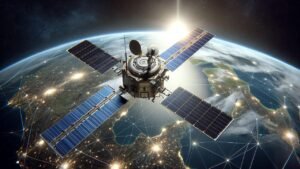
AI has crossed a line: we’re no longer only training models on Earth and deploying them to space. We’ve started training models in orbit.
In 2023, Oxford researchers trained a machine learning model on a satellite. That single step signals a broader shift—satellites becoming autonomous systems that adapt, learn, and act without waiting on a ground link.
“Researchers have trained a machine learning model in outer space, on board a satellite. This achievement could enable real-time monitoring and decision making.”
Why now? Data gravity. Earth observation is exploding. Downlink bandwidth and latency aren’t keeping up. Meanwhile, NASA and partners are investing in large, open geospatial models (for fires, floods, agriculture) and space-weather forecasting. Onboard AI closes the loop from sensing to action.
Here’s the part most people miss: the win isn’t just faster inference. It’s on-orbit adaptation—models that learn from new scenes, sensors, and conditions in real time.
The Actual Move
- Oxford’s in-space training milestone
- Oxford’s team trained a model directly on a satellite in 2023, demonstrating the feasibility of on-orbit learning for tasks like rapid detection and prioritization of data.
- This reduces the need to beam raw data down, saving bandwidth and enabling quicker decisions in disasters or dynamic missions.
“Researchers have successfully trained a ML model in outer space, paving the way for real-time monitoring and decision-making.”
- NASA’s geospatial foundation models (Earth)
- NASA’s Prithvi model was trained on global Landsat data to detect burn scars and other environmental signals.
“Data from Landsat 8 were used to train the Prithvi artificial intelligence model, which can help detect burn scars.”
- Space weather forecasting (Earth-to-space pipeline)
- NASA and IBM introduced Surya, an AI model trained on extremely large solar images to predict solar storms—an example of how foundation models are moving into mission-critical domains.
“The Surya model was trained on an enormous data set, digesting images 10 times larger than on standard AI training data.”
- Onboard robotics getting smarter
- On the ISS, AI is now helping control a free-flying robot, improving navigation and autonomy in dynamic environments.
“This is the first time AI has been used to help control a robot on the ISS.”
- Ecosystem buildout
- Stanford launched a center to push AI for autonomous exploration, connecting academia, industry, and government.
“A new center at the Stanford School of Engineering will leverage artificial intelligence in the service of space science, exploration, and business.”
- Hype watch
- A recent claim suggested an on-orbit Nvidia H100 training a large language model. Given power, cooling, and radiation constraints, this remains unverified and highly implausible with current satellite buses.
“Starcloud Trains First Large Language Model in Orbit, Using Nvidia H100 and Google Gemini.”
The Why Behind the Move
Zoom out and the pattern becomes obvious: training moves to where the data is. In space, that means learning at the edge.
• Model
- Early on-orbit training targets compact models: scene classification, anomaly detection, prioritization. The frontier will be continual learning, lightweight fine-tuning, and self-supervised adaptation.
• Traction
- Practical wins are bandwidth savings, faster alerts, and resilience when ground links are constrained. ISS robotics shows the near-term autonomy payoff.
• Valuation / Funding
- Public-sector pull (NASA, ESA, national labs) plus dual-use private capital will back teams that connect space hardware, edge AI, and mission software. Open models like Prithvi reduce barrier-to-entry for downstream apps.
• Distribution
- The moat isn’t the model—it’s the constellation, the ground segment, and the tasking pipeline. Own the data loop, own the market.
• Partnerships & Ecosystem Fit
- Expect deeper ties between satcom providers, edge compute vendors, and AI labs. Universities anchor talent and credibility; agencies de-risk and define standards.
• Timing
- Training in orbit is early but inevitable. As Earth-bound models like Surya and Prithvi mature, the next step is pushing selective training and adaptation to the sensor edge.
• Competitive Dynamics
- Incumbents with fleets (Maxar, Planet, Airbus) have distribution. Startups win by specializing: on-orbit learning toolchains, radiation-tolerant accelerators, and “autonomy as a service.”
• Strategic Risks
- Reliability and validation: models can be right for the wrong reasons.
“AI models make accurate predictions but fail to encode the world model of Newton’s laws…”
- Safety, governance, and spectrum constraints will slow deployment. Hardware limits (power/thermal/radiation) are real. Beware overclaiming—credible roadmaps beat flashy press.
What Builders Should Notice
- Move compute to the data. Downlink is the bottleneck; autonomy is the unlock.
- Start with fine-tuning and prioritization. Small wins compound into trust and budget.
- Your moat is distribution: satellites, tasking, and ground ops—not just the model.
- Validate under constraints: power, thermal, radiation, and intermittent comms.
- Open models accelerate you—mission integration differentiates you.
Buildloop reflection
“Autonomy scales when learning happens closest to the signal.”
Sources
- University of Oxford — Researchers successfully train a machine learning model in outer space for the first time
- Awaz Live — A Nvidia H100 Is Orbiting Earth Right Now: Here’s Why
- NASA — Expanded AI Model with Global Data Enhances Earth Observation
- Space.com — Meet Surya, the 1st-of-its-kind AI model NASA and IBM built to predict solar storms
- SpaceDaily — AI advances robot navigation on the International Space Station
- SwissCognitive — Researchers Are Training A Machine Learning Model In Outer Space
- Stanford Engineering — New center harnesses AI to advance autonomous exploration of outer space
- ScienceDaily — Researchers successfully train a machine learning model in outer space for the first time
- The Algorithmic Bridge — Harvard and MIT Study: AI Models Are Not Ready to Make Physical Predictions