What Changed and Why It Matters
The AI market is pivoting from chat-first interfaces to workflow-first systems. The signal is clear across operator blogs, dev platforms, and consulting shops.
Enterprises want outcomes, not conversations. They want steps, states, and actions. Chat is still useful, but it’s no longer the center of gravity.
“Chat tools are great for quick, isolated tasks… AI workflows mirror our natural content creation process, resulting in higher quality output.” — Nathan Thompson (Substack)
“Workflow automation handles routine tasks. AI chatbots focus on front-end communication, simulating human conversation.” — Goodfellas Tech
Here’s the part most people miss: agentic features don’t win by themselves. Reliability, orchestration, and integration do. The winners are turning LLMs into predictable engines that move work through a system.
The Actual Move
Across the ecosystem, builders are embedding AI inside repeatable workflows that trigger, act, and close the loop.
- From “chat to action”: AI is shifting from answering to executing.
- Embedded in ops: invoice processing, lead qualification, and support triage are becoming AI-first flows.
- DevOps adoption: incident runbooks and proactive aides guide teams through steps, not chats.
- Cross-channel integration: AI connects websites, forms, email, and back-office tools to drive real outcomes.
- Modular systems: components can be updated, retrained, or swapped without breaking the whole.
“A chatbot is primarily a communication tool; an AI‑enhanced workflow is an action engine.” — PowerTech365
“A custom-built, specialized AI system is a modular asset… easier to update, retrain, or replace a component.” — Baytech Consulting
“Visualising insights instantly… Triggering real actions… Integrating across every channel.” — Incheck Software
“AI workflows act as proactive aides, predicting what needs to be done.” — Copilot4DevOps
Even workflow tool vendors say it plainly: chat is for one-offs; workflows run your business.
The Why Behind the Move
• Model
LLMs are probabilistic. Workflows add structure: steps, guards, and human-in-the-loop. This converts best-effort chat into reliable execution.
• Traction
Teams adopt what plugs into existing systems. Workflow AI ties to CRMs, ticketing, billing, and data warehouses. That’s where usage compounds.
• Valuation / Funding
Investors reward durable revenue, not demo delight. Actionable workflows lock in value via measurable outcomes and lower churn.
• Distribution
Workflows live where work happens. Embedding into Salesforce, Slack, Zendesk, or custom ERPs beats a standalone chat window.
• Partnerships & Ecosystem Fit
APIs are the moat. Integrations with core systems, identity, logging, and governance turn AI into infrastructure, not a feature.
• Timing
Post‑chatGPT reality: expectations rose, trust lagged. Workflows restore trust with evals, approvals, and deterministic gates.
• Competitive Dynamics
Chat UX is commodity. Repeatable processes, domain data, and closed-loop feedback build defensibility.
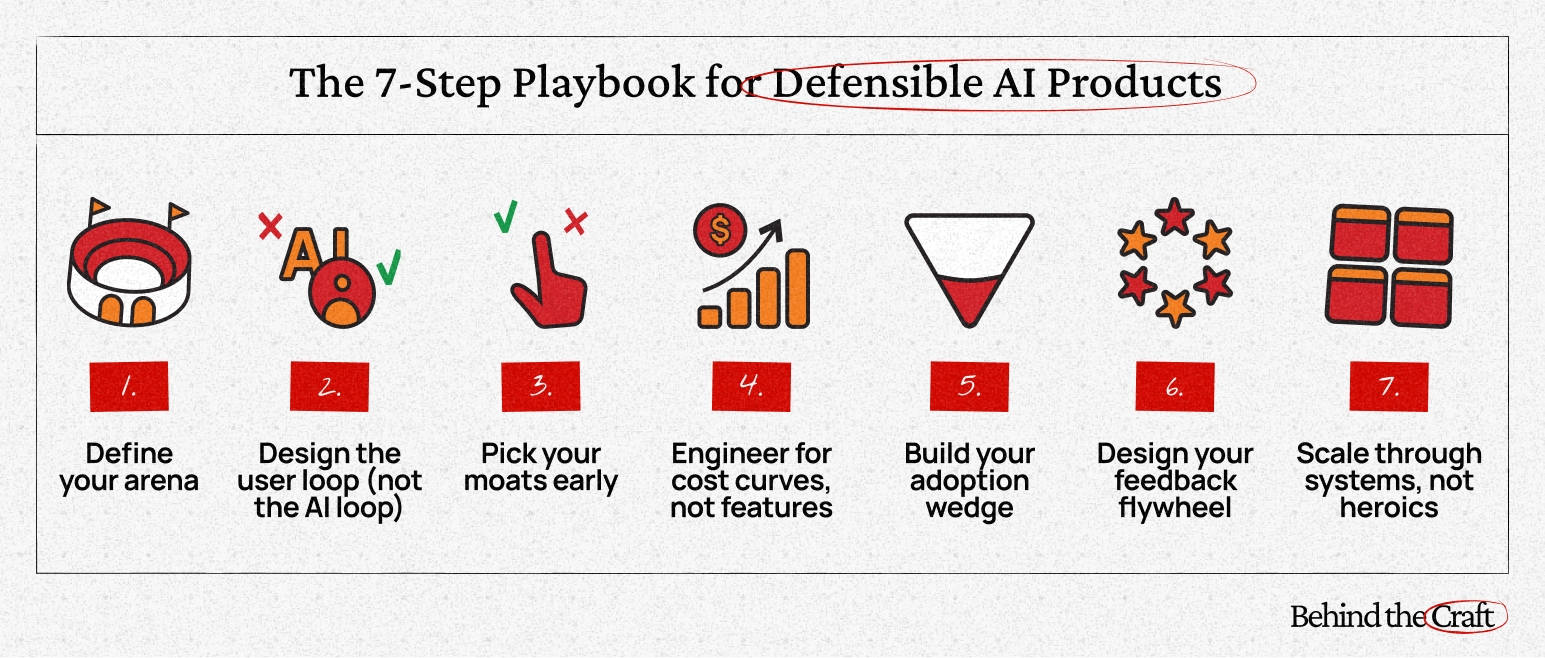
“Pick your moat, design user loops, and engineer for cost curves.” — The 7‑Step Playbook for Defensible AI Products
• Strategic Risks
- Over-automation without clear guardrails.
- Integration sprawl creating fragile systems.
- Hidden inference costs at scale.
- Vendor lock‑in without data portability.
What Builders Should Notice
- Build action engines, not chat windows.
- Start with a narrow, high‑value workflow. Expand by adjacent steps.
- Instrument everything: evals, retries, fallbacks, and human review.
- Own integration depth. Shallow connectors don’t compound.
- Design cost curves early: caching, small models, and routing.
“Workflow beats wow. Reliability is the real feature.”
Buildloop reflection
Every durable AI product is a workflow with opinions.
Sources
- Substack — AI Workflows vs. AI Chat – by Nathan Thompson
- Goodfellas Tech — AI Chatbots vs Workflow Automation: What’s Best for Your …
- PowerTech365 — Why AI Workflows Beat Chatbots: The Strategic Advantage of Embedded Intelligence
- Budibase — AI vs Automation for Managing Workflows
- YouTube — The Difference Between Chat vs Workflows
- Baytech Consulting — AI Beyond Chatbots: The Executive Playbook for a …
- Creator Economy — The 7-Step Playbook for Defensible AI Products
- Copilot4DevOps — AI Workflows: A Simple Way to Make Business Operations …
- Incheck Software — AI Is More Than Just ChatGPT: It’s a Workflow Engine