
For two decades, Google defined how the world searched the internet. Billions of queries. Billions in ad revenue. Total dominance.
Then in late 2022, a small team launched Perplexity AI with a simple conviction:
Search should give you answers, not ads.
That clarity has turned Perplexity into one of the fastest-growing AI startups of our time, valued in the billions and challenging Google where it hurts most.
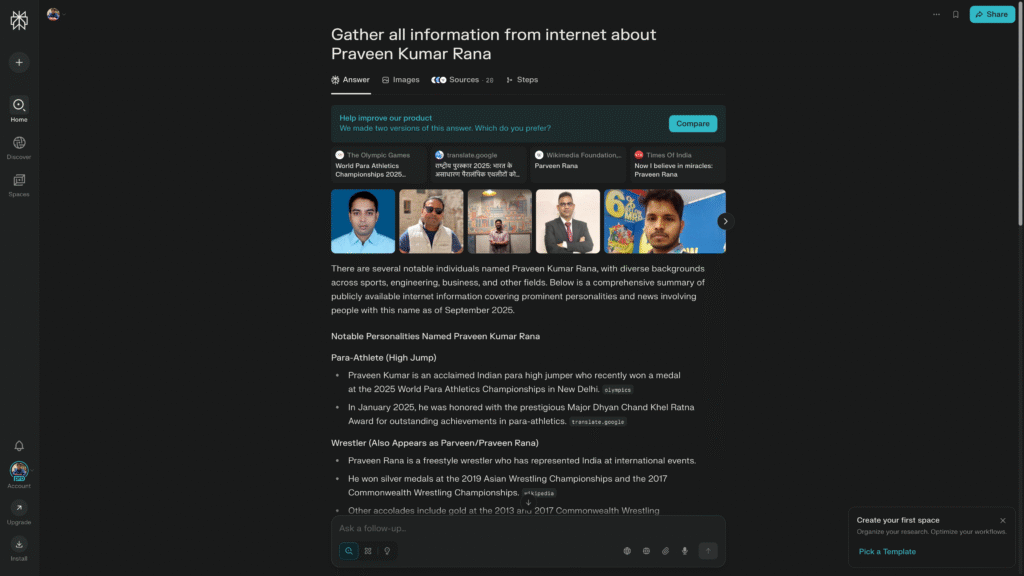
The Backstory: From Chennai to Silicon Valley
Perplexity was founded in 2022 by Aravind Srinivas, Denis Yarats, Johnny Ho, and Andy Konwinski.
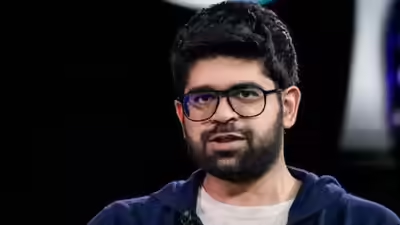
- Aravind grew up in Chennai—the same hometown as Sundar Pichai. His mother once dreamed of him entering IIT. He not only made it but later went on to UC Berkeley for a PhD.
- After stints at OpenAI and DeepMind, Aravind turned his focus to a bigger question: what if search could be reimagined for the AI era?
From that conviction, Perplexity AI was born. Not another chatbot. Not a productivity suite. But an answer engine designed to rethink search itself.
The Product Bet: Focus, Not Fluff
Perplexity launched publicly in December 2022. The space was already crowded with AI experiments—but Perplexity leaned into a different path.
- Hybrid search + AI
- Instead of just spitting out generative text, it grounds answers in real-time web data.
- Inline citations
- Every answer shows sources—building credibility from day one.
- Freemium model
- Free search for all; paid tiers unlock advanced models like GPT-4 and Claude.
- Perplexity Pages
- A built-in tool that turns research into clean, shareable reports.
By staying focused on search alone, Perplexity built sharper trust and usability than “AI can do everything” products.
Growth Numbers That Matter
- Unicorn status reached in 2024.
- Valuation estimated at $14–18 billion in 2025.
- 780 million queries in May 2025 with 20% month-over-month growth.
This isn’t hype. It’s real adoption—proof that people were ready for a Google alternative.
Key Strategic Moves
1. Launching Comet: Their Own Browser
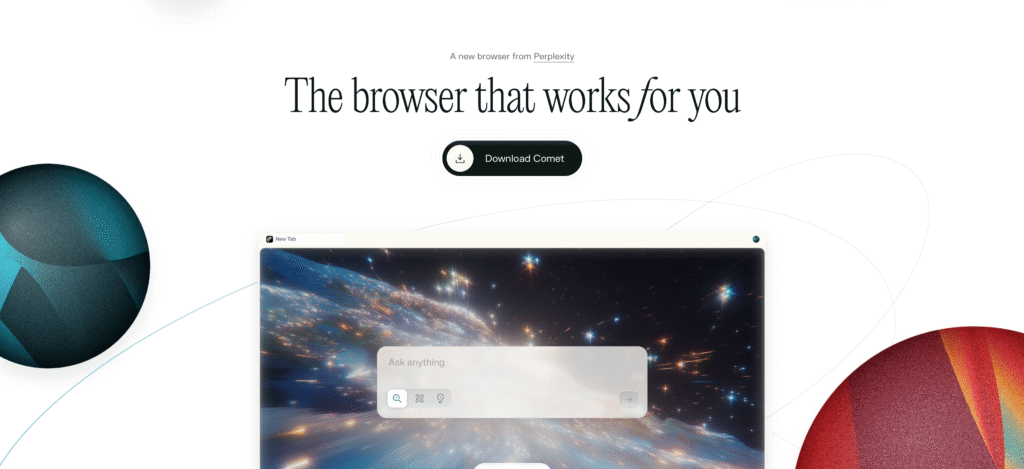
In 2025, Perplexity introduced Comet, a Chromium-based browser integrated with its search and assistant features.
This was a direct shot at Google Chrome—making Perplexity the default way users interact with the web.
2. Aligning With Publishers
Facing backlash from news outlets over content scraping, Perplexity rolled out a revenue-sharing program with publishers whose work is cited in answers. This move tries to turn potential enemies into allies.
3. The Bold Chrome Bid
Perplexity made headlines with a $34.5 billion all-cash bid to acquire Google Chrome. Whether realistic or not, it signaled their ambition: they’re not just a startup—they want to own the stack.
Controversies & Pushback
Every disruptor faces friction. For Perplexity, it’s serious:
- Copyright battles
- Accused of scraping content despite blocks (NYT, BBC, Dow Jones). Wired and Cloudflare reports suggest stealth crawlers may bypass restrictions.
- Trust issues
- Critics have called it “a bullshit machine” when answers misquote or hallucinate.
- Trademark fights
- Other companies have challenged Perplexity’s name.
- Scaling costs
- Running LLMs, crawling the web, and licensing AI models is expensive. Monetization needs to keep pace.
These challenges are real—and how Perplexity handles them will shape its long-term survival.
Founder Lessons From Perplexity
For builders like us, here’s the playbook worth stealing:
- Pick one wedge problem: They chose search—a universal pain point—and went deep.
- Build trust into design: Citations weren’t optional; they were a moat.
- Move where giants can’t: Google’s ad machine is its weakness. Perplexity exploited it.
- Distribution matters: Mobile apps, browser extensions, now a full browser—they ship where users live.
- Boldness attracts momentum: Unicorn valuations, billion-dollar bids—sometimes audacity itself becomes marketing.
What’s Next for Perplexity?
To cement its place, Perplexity must:
- Make Comet sticky enough to change user habits.
- Invest in multimodal AI (voice, images, video) to stay ahead.
- Build real alliances with publishers to reduce lawsuits.
- Localize search for global markets like India.
- Deliver enough value in Pro and Max plans to keep monetization sustainable.
The road won’t be smooth. But if Perplexity holds its focus, it won’t need to “kill Google.” Even carving out a slice of professional, educational, and research-driven search is already a multi-billion-dollar play.
Final Word
At Buildloop.ai, we talk about clarity, conviction, execution.
Perplexity embodies that.
They picked one problem.
Built a sharper alternative.
And proved you can challenge giants if your product is better.
The lesson for us as founders is clear:
- You don’t need to build for everything.
- You just need to do one thing—and do it better than anyone else.
Perplexity AI shows us the future of search: clean, direct, AI-powered, and built for users, not advertisers.