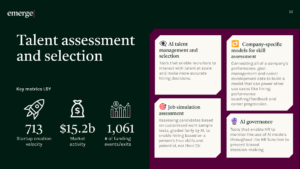
AI soaked up roughly 80–81% of global VC in Q1 2026—about $239B of a record $297B quarter.
What Changed and Why It Matters
Venture funding just reset the ceiling. Reports indicate Q1 2026 marked an all-time high of around $297B in global VC, with AI capturing about $239B—roughly 80–81% of the total.
Why it matters: this is not a one-off spike. In Q1 2025, global VC was far lower and AI’s share was meaningfully smaller. The U.S. alone saw AI take 71% of VC in Q1 2025, and one $40B AI megadeal doubled that quarter’s activity—clear signs that mega-rounds drive step-changes. By late 2025, foundation model companies had already raised tens of billions for the year. Q1 2026 likely eclipsed that full-year pace.
Here’s the part most people miss: capital isn’t chasing apps; it’s consolidating around compute, data centers, and the handful of model platforms that can translate scale into distribution.
The Actual Move
This quarter’s “move” wasn’t a single product or company—it was a capital rotation into AI at unprecedented concentration and speed.
- Global VC hit roughly $297B in Q1 2026—the strongest quarter on record.
- AI absorbed about $239B, or ~80–81% of all venture dollars.
- Multiple outlets note the AI share jumped sharply from 2025 levels. Some peg Q1 2025 AI share near 50–55% globally, 71% in the U.S., then ~81% in Q1 2026.
- 2025 data shows foundation model and AI infrastructure players already dominated dollar volume; Q1 2026 amplified that dominance with late-stage mega-rounds.
Taken together: mega-rounds returned, crossover capital re-entered, and AI infrastructure and foundation model platforms captured most of the spoils.
The Why Behind the Move
Zoom out. The pattern is consistent with a platform shift maturing from prototypes to deployment.
• Model
- Training economics favor scale. Foundation model companies with access to compute, data, and distribution attract outsized rounds.
- Infrastructure—chips, data centers, model hosting, MLOps—acts like the picks-and-shovels layer in a modern gold rush.
• Traction
- 2025 enterprise pilots turned into budgets. Copilots, customer support agents, and workflow automation crossed into production.
- Infra-first spending grows before app-layer revenue catches up.
• Valuation / Funding
- Late-stage appetite returned where growth plus platform potential is clearest.
- The market is underwriting category leaders and infra providers with defensible scale.
• Distribution
- Hyperscaler channels, cloud marketplaces, and SI partnerships accelerate go-to-market.
- GPU access has become a distribution lever—compute availability draws both developers and dollars.
• Partnerships & Ecosystem Fit
- Model labs pair with clouds for scale, credits, and GTM. Infra players align with data center and energy partners.
- Open-source and enterprise tooling integrate into these platforms, deepening lock-in.
• Timing
- New GPU cycles and expanding data center capacity met rising enterprise demand.
- After 2024–2025 resets, capital was primed for a platform-scale bet.
• Competitive Dynamics
- Winner-take-most dynamics intensify at the model and infra layers; app-layer differentiation compresses.
- The defensible moats: distribution, data gravity, partnerships, and reliable performance at scale.
• Strategic Risks
- ROI lag: deployment outpaces measurable payback in many use cases.
- Supply-chain and power constraints: compute and energy availability shape who can scale.
- Platform dependency: margins compress if you rely solely on hyperscalers.
- Regulatory scrutiny: data use, safety, and model accountability will influence cost and speed.
Record funding does not equal record returns. The ROI lag is real—and it’s the next filter for winners.
What Builders Should Notice
- Build on the rails that scale. If you’re not infra or a model lab, partner with them early.
- Measure hard ROI, not just productivity glow. Budget cycles need proof, not promises.
- Distribution is the moat. Hyperscalers, SIs, and embedded channels beat standalone funnels.
- Barbell strategy wins. Go deep in a niche workflow—or ride platform primitives broadly.
- Capital efficiency matters again. Show path to gross margin and unit economics in AI workloads.
Buildloop reflection
AI rewards speed—only when it compounds into distribution and durable ROI.
Sources
- Crunchbase News — Q1 2026 Shatters Venture Funding Records As AI Boom …
- Trending Topics — VC Hits $297 Billion in One Quarter, AI Swallows 81% of …
- KPMG — Global VC investment rises in Q1’25 on back of record- …
- MLQ.ai — AI Captures Over 71% of US VC Funding in Q1 2025
- Beamstart — Q1 2026 AI Venture Funding Reaches Record $297 Billion, …
- EY — Major AI deal lifts Q1 2025 VC investment
- LinkedIn — AI Captures 50% of Global Venture Funding in 2025
- Crowdfund Insider — AI Funding Surges To Record Highs Q1 2025, Driven By …
- Crunchbase News — 6 Charts That Show The Big AI Funding Trends Of 2025
- AI Empire Media — Breaking: AI Funding Q1 2026 Hits $297B Despite Zero ROI