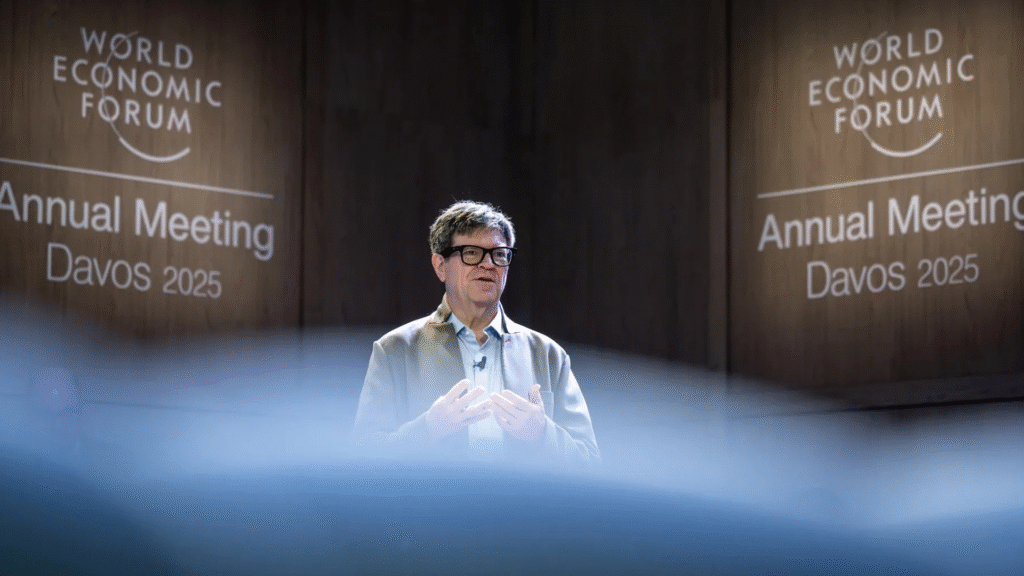
Reports say Meta’s chief AI scientist, Yann LeCun, may chart a new path outside Meta. If he does, that shift won’t just be career news. It’s a signal.
Why it matters: when a principal architect of open AI strategy moves, markets move. Talent reallocates. Research agendas rebase. And founders get new surface area to build.
The signal behind the headline
LeCun has been the loudest voice for open, accessible AI. He pushed Meta’s open model posture (Llama 2/3), community tooling, and “open weights as infrastructure”. He’s also argued that current LLMs hit ceilings without world models and objective-driven systems.
So if he steps into a new vehicle, expect two things:
- A deeper bet on open science + open weights as a compounding distribution strategy.
- A push beyond chatbots toward autonomous systems grounded in perception, memory, and planning.
That combination threatens the binary “closed frontier vs. hobbyist OSS” narrative. It says there’s a third lane: elite, open research with real product velocity.
Clarity over noise. Doctrine beats drift.
Product doctrine: beyond LLMs
Most AI products today wrap retrieval, fine-tuning, and UX around large language models. Useful, yes. Durable moat, not always. LeCun’s worldview has been consistent: LLMs are impressive pattern machines, but incomplete reasoning engines without an internal model of the world.
Translation for builders:
- Don’t just chase bigger context windows. Design memory.
- Don’t just tune prompts. Encode objectives and constraints.
- Don’t just bolt tools. Plan, act, and learn from the environment.
If a LeCun-led lab ships JEPA-style architectures or world-model agents as open building blocks, we’ll see a wave of products that feel less like Q&A and more like systems that do work. That’s a new UX surface for ops, robotics, code, creative tooling, and enterprise agents.
Strategy math: talent, compute, capital
This is where founders should read between the lines.
- Talent gravity: Principal researchers spawn ecosystems. Look at SSI from Ilya Sutskever, and how one thesis attracted capital, collaborators, and customers overnight. If LeCun seeds a lab, expect a tight loop of postdocs, ex-Meta engineers, and OSS contributors.
- Compute: Frontier training now costs in the hundreds of millions per generation, with inference often dominating long-term spend. You win by mixing cloud credits, strategic GPU reservations, and clever distillation—paired with an open community that helps test, benchmark, and harden.
- Distribution: Open weights aren’t charity. They’re go-to-market. Mistral proved that permissive models, crisp APIs, and sharp docs can monetize while compounding community goodwill. Meta did similar at internet scale with Llama.
If LeCun’s next chapter stays open, expect a model: open core, paid infra and enterprise safety layers, plus partnerships where compute and data come bundled.
What this means if you’re building now
Founder lens. Practical moves.
- Pick a doctrine. Closed vs. open is not religion. It’s positioning. If you go open, monetize infra, trust, and SLAs.
- Bet on systems, not stickers. LLM wrappers fade. Work-producing agents endure.
- Own a loop: data → training → eval → deployment → feedback. Tight loops beat parameter counts.
- Ship reference apps. OSS plus a great reference product is distribution you don’t need to buy.
- Compute is a supply chain. Treat GPUs like inventory. Hedge across cloud, on-prem, and partner credits.
- Design for autonomy boundaries. Start with bounded tasks. Expand capability only when reliability is high.
- Measure cost-to-outcome, not cost-per-token. Customers pay for outcomes.
Founder checkpoints (fast audit)
- Can you state your learning objective in one sentence?
- Do you have a private dataset or workflow interface others can’t easily copy?
- Is your eval suite predictive of customer trust, not just leaderboard deltas?
- What’s your plan when the model doubles in cost or halves in latency?
Buildloop reflection
Bold moves attract momentum. If LeCun goes founder-mode, expect a sharper open playbook and a new wave of systems that do real work—beyond chat.
Sources
- Meta’s chief AI scientist Yann LeCun reportedly plans to …
- Meta’s AI chief Yann LeCun reportedly leaving for new …
- AI’s Next Five Years: LeCun Predicts a Physical-World …
- Meta chief AI scientist Yann LeCun plans to exit to launch …
- Why LeCun is Betting on World Models (and Why Builders …
- The $100 Trillion Bet: Why World Models, Not LLMs, Define …