What Changed and Why It Matters
Enterprises are moving from AI experiments to workflow automation. The pattern is consistent across sectors: compose on top of what already works.
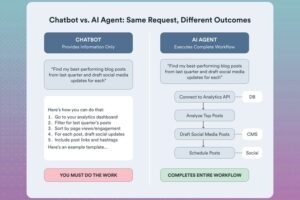
This week’s signals span industrial platforms, enterprise support, marketing ops, lab automation, and public programs. The common thread is integration over replacement. Agents sit inside CRM, MES, ERP, or marketing stacks, not beside them.
Here’s the part most people miss. The speed comes from grafting AI onto existing systems and data, not from ripping them out.
“Using a composable platform to graft AI onto existing systems rather than…”
The Actual Move
- Accenture’s Industrial AI stance, highlighted in a LinkedIn post, argues for composable platforms. The goal: layer AI atop live industrial systems instead of rebuilding them.
- Salesforce continues its push into AI automation. A Forbes post notes the company rolled out AI agents in customer support to cut costs and speed response times.
“Salesforce rolled out AI agents in its customer support organization, with the goal of cutting costs and speeding up…”
- Montreal-based gaiia is building AI agents that plug into enterprise marketing systems to automate campaign workflows. It’s led by co-founder and CEO Doug Tallmadge.
- The UK’s Hartree Centre baseline evaluation shows added programmes focused on industrially relevant software with academic partners.
“Two new programmes… working with UCL to develop industrially relevant software associated with BAC.”
- Informa’s latest annual report underscores a company-wide move to AI-first workflows across functions, including finance and accounting.
“We are re-imagining workflows in all our key functions to bring the benefits of AI into all our daily processes.”
- On the hardware side, automated sample management equipment emphasizes reliability in end-to-end automated workflows.
“Designed for hassle-free operation and stability in automated workflows.”
- Venture Kick’s portfolio highlights breadth: AI-for-marketing automation, energy-autonomous biosensors, and contactless robotic grippers. The startup pipeline around automation is diversifying fast.
- For context, factory automation blends control systems (PLCs), supervisory software (SCADA), and manufacturing execution (MES). AI agents are now threading through these layers.
The Why Behind the Move
This shift optimizes for time-to-value and risk control. Composability beats greenfield rebuilds in regulated, complex environments.
• Model
Agentic workflows are stitched to live systems through connectors, APIs, and event streams. Think: CRM tickets, MES work orders, ERP inventory, and campaign objects.
• Traction
Support and marketing are early wins. They have clear KPIs, abundant data, and repeatable tasks. Industrial teams adopt where safety and uptime are protected.
• Valuation / Funding
Public programmes and venture pipelines are leaning into automation. It de-risks adoption and creates reference customers for startups.
• Distribution
Winners meet users inside existing tools. Salesforce leverages CRM distribution. System integrators and SI-led platforms bring reach into factories and plants.
• Partnerships & Ecosystem Fit
SIs, OEMs, and universities matter. They unlock data access, compliance know‑how, and change management—critical in industrial contexts.
• Timing
LLMs and orchestration are stable enough for narrow, supervised tasks. Governance, logging, and human-in-the-loop patterns have matured.
• Competitive Dynamics
The moat isn’t the model; it’s embeddedness. The deepest moats come from integrations, data permissions, and day‑to‑day workflow control.
• Strategic Risks
- Process drift from over-automation
- Security and data exfiltration across connectors
- Latency or downtime impacting core operations
- ROI washout if agents aren’t tightly scoped and measured
What Builders Should Notice
- Compose, don’t replace. Integrations unlock faster adoption and budget.
- Start with bounded workflows tied to clear KPIs. Prove ROI in weeks.
- Distribution beats raw model quality. Ship inside tools users already trust.
- Treat safety and observability as product features, not add‑ons.
- Partner early with SIs or OEMs to accelerate data access and compliance.
Buildloop reflection
In automation, integration beats invention.
Sources
- Quora — What are factory automation systems?
- LinkedIn — László Zsolt Tófalvi’s Post
- Forbes — For years, Salesforce has been the dominant tool for sales …
- Instagram — gaiia, a Montreal-based provider of an AI-native operating …
- STFC Hartree Centre — Hartree Centre Phase 1 & 2 Baseline Evaluation
- Informa — Informa Annual Report 2025
- Rackspace CDN — Automated Sample Management
- Venture Kick — venture kick in the news