AI chatbots have raced to mass usage. Profits are still missing. Investors keep funding the buildout. Enterprises still hold back where money changes hands.
This is the monetization gap: big user numbers, stubbornly thin margins, and unclear moats. It matters because cost curves and capital cycles don’t wait. Builders need revenue models that survive higher compute bills and tougher distribution.
What Changed and Why It Matters
Generative AI moved from demos to daily use. Cloud providers doubled down. But the business model lagged.
- Startups captured attention and valuations before proving revenue. Many now face margin pressure from expensive inference.
- Enterprises are adopting AI in back-office tasks but hesitate on client-facing use—the highest-ARPU workflows.
- Distribution is shifting from open web search to closed-answer chat, threatening the ad-supported ecosystem that funded content and discovery.
“IT spending on AI services and algorithmic training continues to grow, even though the path to monetization is proving longer than expected.”
“AI companies working on foundation models have yet to even break even.”
Zoom out and the pattern becomes obvious: usage is not the same as unit economics. Without a moat and a model, scale compounds cost—not profit.
The Actual Move
This isn’t one company’s announcement. It’s a set of converging signals across the stack.
- Valuations outpace revenue
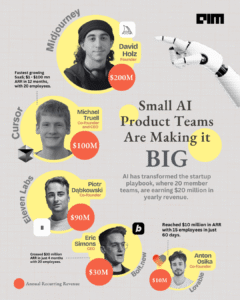
- > “Fewer than 25 pure AI startups [are] generating more than $10 million in revenue,” per Theory Ventures’ Tomasz Tunguz.
- > “Without A.I.’s version of a moat, companies might struggle to monetize the technology and fail to live up to their current valuations.”
- Hyperscalers keep spending; monetization takes longer
- > “IT spending on AI services and algorithmic training continues to grow, even though the path to monetization is proving longer than expected.”
- Foundation model economics are still brutal
- > “The core problem isn’t just that OpenAI spends too much. It’s that there’s no realistic path to profitability given their current trajectory.” (author’s view)
- Enterprises draw a line on customer contact
- > “AI can handle operational work, but most companies… draw a sharp line at client communication.”
- Distribution power is shifting—and straining the ecosystem
- > “AI chatbots are reducing traffic to publishers’ websites by a staggering 96% compared to traditional search engines.”
- Dealmaking is messy under uncertainty
- > “Five months after Meta’s $14 billion investment into Scale AI, the once-buzzy startup is facing turmoil.”
- Public markets reward the story, not the profits (yet)
- > “With investors homing in on AI stocks, management… continued to call out generative AI on earnings calls.”
The Why Behind the Move
Builders need a lens for what’s optimizing—and what’s not.
• Model
Inference costs remain high and variable. Caching, distillation, and small models help, but the core unit economics are sensitive to prompt length and latency SLAs. Pure chat UIs rarely monetize at a rate that covers heavy usage.
• Traction
Top chatbots post huge sessions and engagement. Enterprise pilots are robust in ops, QA, and summarization. But the most valuable workflows—client communication, transactions, and compliance-heavy actions—are gated.
• Valuation / Funding
Capital chased compute more than cash flow. As rates stay higher and GPU supply loosens, multiples compress toward revenue quality. The bar shifts from “can it scale?” to “can it profit at scale?”
• Distribution
Search-to-chat shifts keep users inside answer boxes. That’s good for UX, bad for ad-funded publishers, and fragile for startups without owned channels. The moat isn’t the model—it’s default placement, partnerships, and retained workflows.
• Partnerships & Ecosystem Fit
Heavy dependence on hyperscalers creates margin and bargaining risk. Vertical data partners, browser and OEM distribution, and enterprise SIs can offset—but only with aligned incentives and clear rev-share.
• Timing
Infra spend is front-loaded; monetization lags. Early winners will be those who move from generic chat to embedded workflows where value is measurable and chargeable.
• Competitive Dynamics
Foundation model providers, cloud platforms, and application layers blur. Differentiation must come from domain data, proprietary loops, and trust. Commodity answers will be free.
• Strategic Risks
- Gross margin drag from inference and context expansion
- Platform dependency on a few clouds and model APIs
- Publisher backlash and regulatory scrutiny over content use
- Enterprise trust, safety, and liability concerns
What Builders Should Notice
- Move from chat to workflows with P&L impact. Price on outcomes—leads, closed tickets, code merged, time saved.
- Design for margin from day one. Cache aggressively, compress prompts, fine-tune small models, and route smartly.
- Own distribution. Secure default placements, integrate where work already happens, and build retention loops beyond answers.
- Build trust as a feature. Audit trails, controllable tone, safety rails, and domain guarantees unlock client-facing use.
- Don’t scale the burn rate on vanity metrics. Ship revenue experiments early: seats, usage tiers, API, and value-based SKUs.
Buildloop reflection
“In AI, the answer is cheap. Trusted outcomes are what compound.”
Sources
Yahoo Finance — AI Can Do a Lot — But Most Companies Don’t Want It …
Yahoo Finance — AI startups still snag huge valuations despite lack of revenue
Medium — OpenAI Is Burning $12B Every Quarter With No Clear Path to …
TechSpot — Cloud giants keep spending on AI, while traditional IT …
Yahoo News Malaysia — Major AI Companies Aren’t Even Pretending to Make Money
AIBase — AI Chatbots Devour Traffic: Publishers Face 96% Drop Crisis
Yahoo Finance — Don’t bet on the A.I. boom leading to massive profits. Just …
Investor’s Business Daily — AI Stocks: In Case You Missed It This Week On Artificial …
Yahoo Finance — Dealmaking in the AI age is tricky