What Changed and Why It Matters
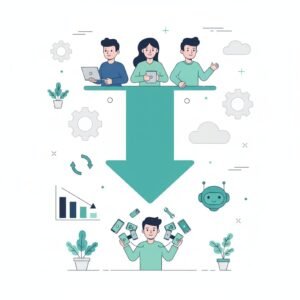
The org chart is changing. Boxes now include humans and AI agents. Hiring is shifting from titles to skills, from static roles to dynamic workflows.
This is not a blip. It shows up across labor data, executive playbooks, and org design guidance. Indeed’s Hiring Lab finds nearly half of skills in U.S. job postings are now GenAI‑affected. The Bureau of Labor Statistics has started modeling AI’s impact in its long‑term projections. And practitioners are literally drawing AI elements into org charts to show where work now lives.
“Almost half (46%) of skills in a typical US job posting are poised for ‘hybrid transformation’ by GenAI. Human oversight will remain critical.”
Zoom out and the pattern becomes obvious: GenAI is moving from “tool” to “teammate.” That rewires how startups hire, train, and structure teams.
The Actual Move
Ecosystem signals point to a common move: redesign work around AI‑augmented workflows and new supervisory skills.
- Labor composition is shifting. Indeed Hiring Lab reports 46% of skills in U.S. postings face hybrid transformation. Oversight and judgment rise in value.
- Government modeling is updating. The BLS is incorporating AI into employment projections and notes LLMs’ augmenting effects.
“New LLMs and GenAI are well suited to augment worker efforts and increase productivity. Software developers can use GenAI to develop, test, and document …”
- Org charts are being redrawn. Reworked urges teams to place AI’s functional elements directly on the chart to clarify ownership and flow.
“By adding the functional elements of AI to an org chart, organizations are … naming (and showing, visually) where the work lives, and how …”
- The talent pyramid is tilting. Forbes Tech Council flags a mid‑career gap as entry‑level work automates and upskilling lags.
“As people upskill and AI automates entry-level work, how does HR develop the talent pool to fill experienced mid-career roles?”
- Roles are evolving. LinkedIn highlights routine task automation, new positions, and reshaped pathways as GenAI spreads across functions.
- Enterprise playbooks converge. KPMG and Deloitte emphasize GenAI’s value in growth, productivity, and experience, pushing skills‑based orgs and “superteams.”
“GenAI drives value for organizations by accelerating growth, boosting profitability, improving productivity, and enhancing experiences.”
- Operating models are in flux. MIT Sloan Review argues GenAI undermines classic hierarchies, requiring redesign of teams, governance, and platforms. Databricks points to concrete shifts across workforce, process, and operations.
- Public sentiment is sober. Brookings notes most Americans expect major job impacts, mainly negative, underscoring the need for clear safeguards and reskilling.
The Why Behind the Move
Startups don’t need bigger orgs. They need clearer workflows, better leverage, and stronger oversight. GenAI delivers leverage. But it also demands redesign.
• Model
- Move from role‑based staffing to task‑and‑agent design.
- Put “AI boxes” on the org chart with named owners and SLAs.
- Keep humans in the loop for judgment, safety, and exception handling.
• Traction
- Job ads increasingly reference AI familiarity and prompt‑level skills.
- Cross‑functional teams pair operators with embedded AI capabilities.
• Valuation / Funding
- Falling inference costs improve ROI on augmenting workflows.
- Capital prefers provable unit economics: quality, speed, and margin gains per task.
• Distribution
- Capability spreads faster via platformized services than isolated pilots.
- Central enablement plus embedded adoption beats a siloed AI Center of Excellence.
• Partnerships & Ecosystem Fit
- HR, IT, Legal, and Security must co‑own standards.
- Data quality, governance, and access controls are now part of “org design.”
• Timing
- With BLS projections, consulting playbooks, and org‑design patterns maturing, the risk of waiting now exceeds the risk of starting.
• Competitive Dynamics
- Startups can rewire faster than incumbents with legacy process debt.
- The moat isn’t the model. It’s proprietary data, workflow integration, and trust.
• Strategic Risks
- Entry‑level automation can starve the mid‑career pipeline.
- Quality drift, hallucinations, and data leakage require explicit controls.
- Worker anxiety is real; transparency and upskilling are retention strategies.
What Builders Should Notice
- Draw the new org: include AI agents, owners, escalation paths, and KPIs.
- Hire for oversight: context, judgment, and prompt/system design beat keywords.
- Protect the talent ladder: apprenticeships and rotational programs fill the mid‑career gap.
- Instrument your AI: track quality, latency, cost per task, and human‑time saved.
- Treat governance as product: version prompts, test datasets, and audit outputs.
Buildloop reflection
The org chart is product design. GenAI just made that literal.
Sources
- Indeed Hiring Lab — AI at Work Report 2025: How GenAI is Rewiring the DNA of Jobs
- Forbes — Reshaping The Pyramid: AI’s Impact On Organizational Structure
- Reworked — Humans and AI Agents: Planning the Org Chart of Tomorrow
- LinkedIn — How Generative AI Is Changing Job Roles
- KPMG US — GenAI is reshaping work and the workforce
- MIT Sloan Management Review — Reinventing the Organization for GenAI and LLMs
- Brookings Institution — Generative AI, the American worker, and the future of work
- U.S. Bureau of Labor Statistics — Incorporating AI impacts in BLS employment projections
- Deloitte — Generative AI and the Future of Work
- Databricks — The role of AI in changing company structures and dynamics