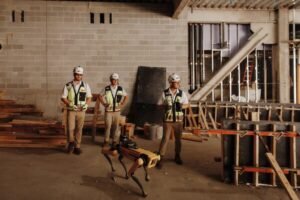
What Changed and Why It Matters
South Korea is shifting from software-first AI to machines that act. The country calls it “physical AI.” Changwon, its factory capital, is becoming the pilot zone.
The signal is clear. National ministries, top committees, and city leaders are aligning around one goal: embed intelligence into production lines, logistics, and equipment. The aim is end-to-end autonomy on factory floors.
“A manufacturing AI ecosystem where robots, equipment, and logistics operate autonomously.” — The Chosun Ilbo (Changwon initiative)
Why now? Korea has world-class manufacturing, robotics, and chips. Generative models matured. Physics-informed AI is viable. The government is pushing a full-stack plan. The result: a coordinated path from chips to shop floors.
Here’s the part most people miss. The bet isn’t just better robots. It’s a re-architecture of industrial value chains around action models, real-time data, and autonomous logistics.
The Actual Move
Changwon City kicked off physical AI manufacturing pilots across its national industrial complex. The city’s goal: tie robots, equipment, and logistics into an autonomous network that cuts cost and boosts throughput.
Two funding moves underscore the hardware turn. BOS Semiconductor and UVify secured ₩147B (~$110M) to scale autonomous chips and industrial drones.
“Korea shifts from AI software to hardware.” — KoreaTechDesk (BOS & UVify funding)
Seoul’s science ministry advanced a technical backbone. It is backing Large Action Model (LAM) research built on Physics-Informed Neural Networks (PINNs). That connects planning, control, and real-world constraints.
“Developing large action model (LAM) technology based on ‘PINN.’” — The Chosun Biz (Science Ministry)
At the policy level, Korea set a “full-stack” physical AI vision for manufacturing and agriculture. That spans silicon, models, robots, and field deployment.
“Full-stack physical AI for manufacturing [and] agriculture.” — The Korea Times
Site checks show execution, not just announcements. The Industry Minister visited Changwon to push upgrades. The National AI Strategy Committee toured local plants to review AI at work.
“Visited Changwon to review how AI is being applied at manufacturing sites.” — Digital Today
Local politics is aligning to lock in the momentum. A leading Changwon mayoral candidate pledged to turn the industrial complex into a “physical AI industry hub.”
“Transform the Changwon National Industrial Complex into a ‘physical AI industry hub.’” — Asiae
Even defense and heavy industry are in scope. Analysts highlight “embedding intelligence” into shipyards and armored vehicle lines as part of the transformation.
“Embedding intelligence directly into shipyards [and] tank factories.” — Stimson Center
The Why Behind the Move
Korea’s strategy reads like a founder playbook for real-world autonomy.
• Model
Physical AI needs action models trained against constraints. PINN-based LAMs reduce sim-to-real gaps and improve safety. This is about reliable control, not just perception.
• Traction
Changwon is a testbed with dense supplier networks. Fast iteration is possible because machines, parts, and maintenance sit within a few kilometers.
• Valuation / Funding
Hardware bottlenecks block autonomy at scale. Backing BOS for chips and UVify for drones ensures compute and sensing reach the edge reliably.
• Distribution
Korea’s manufacturing base is the channel. If physical AI works in Changwon, rollout across shipyards, fabs, and automotive plants becomes straightforward.
• Partnerships & Ecosystem Fit
Ministries, committees, city leadership, and OEMs are coordinated. This reduces integration friction and speeds standards adoption.
• Timing
Generative control stacks matured. Costs for sensors and edge compute fell. Post-pandemic supply chain pressure makes autonomy a CFO conversation, not just R&D.
• Competitive Dynamics
China is scaling robotics fast. Japan has deep industrial automation. Korea’s edge is full-stack integration: chips + models + robots + logistics under one policy roof.
• Strategic Risks
- Over-centralization can miss on-the-ground constraints.
- Vendor lock-in at the chip or platform layer could slow ecosystem growth.
- Safety, labor, and export controls will shape deployment speed.
What Builders Should Notice
- Hardware-software co-design is back. Optimize the stack end-to-end.
- Action models beat task models in factories. Model for decisions, not demos.
- Distribution is the plant network. Land one hub; expand along supply chains.
- Standards are a moat. Interop for robots, PLCs, and digital twins wins deals.
- Measure ROI in throughput and uptime. That’s how autonomy justifies itself.
Buildloop reflection
The next AI edge isn’t smarter prompts. It’s machines that ship work, safely, on time.
Sources
- The Chosun Ilbo — Changwon City Begins Physical AI Manufacturing …
- KoreaTechDesk — Korea Bets Big on Physical AI as BOS and UVify Close …
- Stimson Center — Revolutionizing the Industrial Base: South Korea’s AI …
- YouTube — South Korea Is Building Robots the World Didn’t See Coming!
- Asiae — Changwon Mayoral Candidate Kim Kiwoon: “AI Innovation …
- The Chosun Biz — Science ministry advances physical AI to boost South …
- The Korea Times — Korea eyes ‘full-stack’ physical AI for manufacturing, …
- Let’s Data Science — Industry Minister Advances AI Transformation In Changwon
- Digital Today — National AI strategy committee checks physical AI …
- The Korea Herald — Business