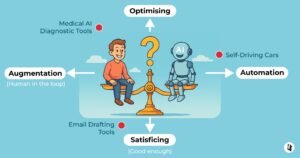
AI is quietly changing who your real customer is. Increasingly, it’s not a person on a page—it’s an agent acting on their behalf.
The shift is clear across CTV, retail, and search: owning distribution beats buying more impressions.
What Changed and Why It Matters
AI is moving from recommendation to transaction. Retailers, ad platforms, and brands are all reorganizing around agent-driven decisions and automated media.
- AI is reshaping connected TV (CTV) buying and operations.
- Retail is preparing for agentic commerce, where software completes purchases.
- Big Tech is publishing AI-first marketing playbooks for 2026.
- M&A is shifting to licensing IP, acquihires, and data access—not full takeovers.
- Founders are rediscovering an old truth: distribution outruns product.
“Generative AI tools are redefining how customers shop, and agents promise to start making purchase decisions themselves.”
Here’s the part most people miss: when agents decide, default placement is destiny. That turns distribution into the primary lever.
The Actual Move
Across the ecosystem, the playbook is converging on one strategy—own the surface where decisions happen.
- CTV: AdExchanger reports AI is rewriting the CTV advertising playbook, creating efficiency and new complexity for buyers and publishers.
“Although AI introduces unprecedented efficiency to the connected TV ad landscape, it also creates a ‘technological disruption’…”
- Brand control: Marketing Dive highlights how brands must assert control amid one-stop AI promises—choosing partners carefully and separating reality from hype.
“As promises of one-stop, AI-powered solutions proliferate, marketers will need to navigate the changed ecosystem and separate reality from [hype].”
- Retail and agents: Tryolabs outlines a practical path from recommendations to transactions—what works, what breaks, and how agentic commerce actually operates.
- Google’s template: TechBuzz.ai notes Google shared three AI marketing strategies on its Ads Decoded podcast aimed at optimizing 2026 campaigns.
“Google released three AI marketing strategies… targeting 2026 campaign optimization.”
- M&A shift: On LinkedIn, the new AI acquisition strategy is about talent, IP access, and licensing—not outright purchases.
“The new AI M&A playbook is no longer about buying companies outright. It is about taking the people, getting access to the IP…”
- Founder reality check: A startup thread crystallizes it in one line.
“Sounds like distribution, not product.”
- Small business execution: The Small Business Expo’s playbook urges automation and personalization to compete with larger brands—an on-ramp to owning your micro-distribution.
- Distribution thesis: Business Engineer frames how AI agents are rewriting the rules—moving from platform-mediated to agent-mediated distribution.
The Why Behind the Move
Zoom out and the pattern becomes obvious: AI compresses the gap between intent and transaction. Whoever controls the last-mile surface wins.
• Model
Agents, recommendation systems, and automated bidding shift value to default placements, structured data, and APIs. You’re optimizing for machine readability and access, not just human persuasion.
• Traction
Paid channels still work, but returns decay as automation saturates. Durable traction lives in owned surfaces (OS-level slots, retail media shelves, CTV inventory guarantees, marketplace defaults).
• Valuation / Funding
Licensing IP and acquihires reduce integration risk and speed learning. Expect more structured deals: access to models, data rights, and teams over full-stack acquisitions.
• Distribution
Buy distribution—don’t just rent it. That means:
- Default placements in marketplaces and retail media networks.
- Preloaded/embedded experiences with OEMs and telcos.
- Publisher and CTV inventory partnerships with data co-ops.
- API-level integrations agents can call by default.
• Partnerships & Ecosystem Fit
Brands will consolidate partners who provide measurement, clean rooms, and agent-compatible feeds. Retailers push closed-loop attribution; publishers seek identity and signal recovery.
• Timing
2025–2026 is the crossover: Google’s guidance, CTV automation maturity, and retail agent pilots signal go-time. Early movers will lock persistent defaults.
• Competitive Dynamics
Walled gardens deepen. Retail media grows. CTV becomes performance media. Open-web players must win on data collaboration, speed, and trust.
• Strategic Risks
- Over-automation without measurement clarity.
- Dependency on a few platforms’ agent interfaces.
- Data rights and brand safety in AI-assembled media.
- Fragmentation across retail and CTV ecosystems.
What Builders Should Notice
- Default beats discovery. Negotiate to be the agent’s first call and the marketplace’s default choice.
- Make your product machine-readable. Structured offers, APIs, real-time availability, clear pricing, provenance.
- Buy channels, not clicks. Seek inventory guarantees, OEM embeds, retail media shelves, and co-branded flows.
- Content still compounds. Own the problem space with SEO and education that agents and humans can parse.
- Contract for data rights. Define how usage, co-training, and attribution work before you scale.
Buildloop reflection
The moat isn’t the model—it’s the default.
Sources
- AdExchanger — AI Is Rewriting The CTV Advertising Playbook
- Reddit — I’ve been building an AI product for 2 years. Growth stalls …
- Tryolabs — When AI can buy: the retail playbook for Agentic Commerce
- LinkedIn — Big Tech’s New AI Acquisition Strategy: Licensing & …
- Marketing Dive — How brands can assert control as AI rewrites advertising’s …
- Wired — The New AI Marketing Playbook
- The Small Business Expo — The AI Agency Playbook For Small Businesses Looking To …
- Business Engineer — The New Rules of Distribution: How AI Agents Are …
- TechBuzz.ai — Google unveils three AI strategies to reshape marketing in …